


By Queensland-based Astronomer Peter Anderson
Whilst many of us visit nearby National Parks on day tours, we may also make trips to special National Parks a distance away requiring a traveller to spend a night nearby, or even better within the park when facilities are available. This provides a wonderful opportunity to explore the night sky.
Astronomical tourism is also encouraged in a number of country areas promoting ‘dark sky’ sites so, if you find yourself out under a dark, star-spangled, country night sky you can explore the wonders of the galaxy. How do you begin, and what do you look at? What equipment do you need?
I suggest that in advance you could download the free planetarium programme ‘Stellarium’ developed by enthusiasts and in wide use. It operates from a single screen and you are able to set up your location, date and time. It is great to explore all manner of astronomical phenomena in the past, present, and future (stellarium.org). It is easy to check out what that bright star you are seeing in the sky happens to be.
Of course I recommend a telescope, but a wonderful start is a pair of binoculars that many readers may already own. A standard pair that has magnifications between 7 and 10 will suffice nicely. The magnification is the first figure on the numbers displayed on it. For example 7X50 means 7 magnifications and 50mm diameter main lenses.
With binoculars you will readily be able to see the larger craters on the Moon, the four bright moons of Jupiter orbiting it, some of the wider double stars, many brighter star clusters and a number of glowing gaseous nebulae, especially along the Milky Way. The wider field of view of binoculars compared to telescopes, can be very beneficial in appreciating extended objects and virtually all amateur astronomers have a pair (or more) handy.
Astronomy is a fascinating subject but it does require some understanding. Nowadays one can purchase and set up ‘go to’ telescopes that will automatically find an object. One disadvantage is the extra expense, and another is that the owner will have learned very little about the night sky. I submit it is better to have learned the basics of celestial mechanics, and like riding a bicycle, the knowledge will stay with you forever. A good start would be to familiarise yourself with Stellarium and then perhaps some basic text on astronomy. The internet can also be a good source, especially ‘Wikipedia’.
But, let us assume that sometime in the next three months you find yourself outside under a dark night moonless sky in the early to mid evening and wonder what you might look at. I suggest that you face south and locate the Southern Cross. If you are not certain please refer to the photograph that will act as the guide.
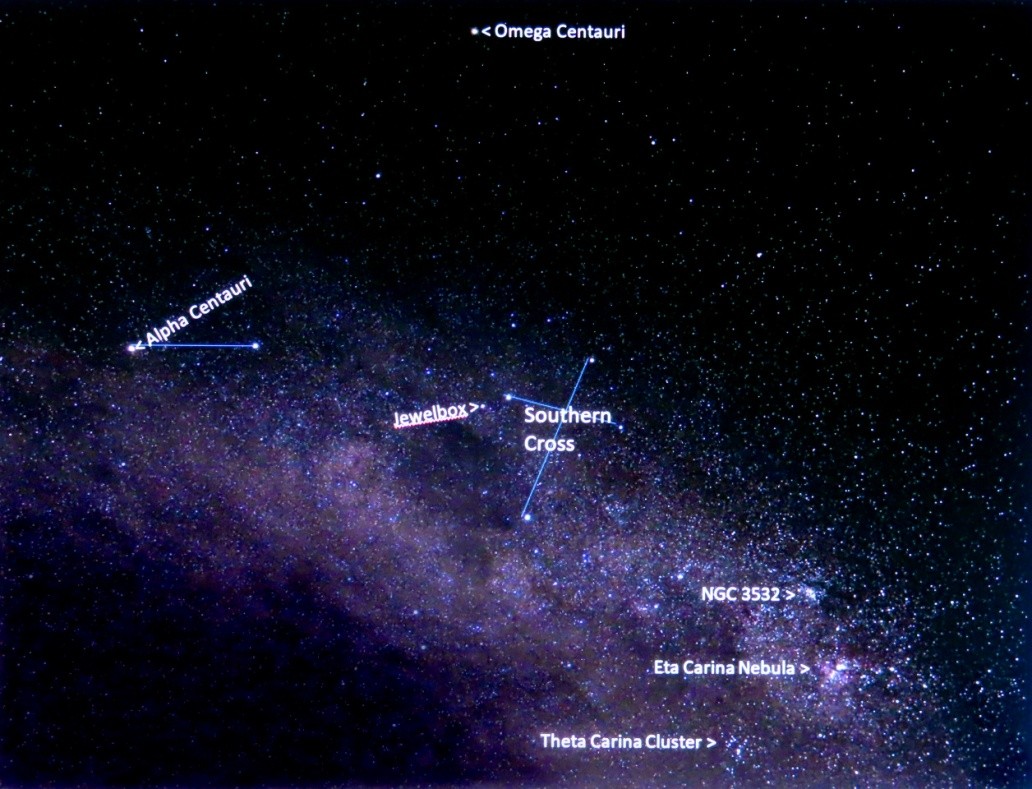
Below are images taken with a 500mm focus lens and this approximates the binocular view that I describe. All are to the same scale so are easy to relate to your view. It is extremely disheartening to the reader if the supporting images were taken using large telescopes that have little relationship to the visual appearance in a small telescope or binoculars.

Once you have found the Southern Cross, you will see a small dark area beside it. This is a cloud of obscuring material in front of the bright Milky Way beyond and is called ‘The Coalsack’.
Stars have a huge range in intrinsic brightness as will be demonstrated by some of the statistics quoted. Our nearest star is of course the Sun and we are the third planet from it. Our distance to the Sun is eight light minutes. This contrasts sharply with the distances to stars that I express in light years, namely the distance that light travels in a year, sometimes in the hundreds and thousands. To the left or lower left of the Southern Cross there are two bright stars that point towards it, joined by a line on the image. The brighter one furthest away is Alpha Centauri, yellowish in colour and a little over four light years distant from us. The other pointer at the right is Beta Centauri 360 light years distant and hotter, being blue-white in colour. This difference in distance between 4 and 360 light years gives a good indication of their relative output of radiation since they seem fairly similar in brightness in our skies.
Alpha Centauri is a double star. Two stars are in an 80 year orbit about each other but a telescope is needed to show them. Marginally closer to us but a little over two degrees away from Alpha in the sky and gravitationally linked to it, is the red dwarf star Proxima Centauri, the closest star to our solar system. Even at such a relatively close distance it is very faint, beyond the reach of binoculars.
Next to the Cross near the Coalsack, binoculars will reveal a small triangular cluster of stars that is called the Jewelbox because in a telescope a number of its stars display different colours. The different colours of stars is caused by different surface temperatures akin to the colour and temperature of flames. Look for stars of different colours and you will certainly see the colours blue-white, white, yellow, and some orange among the brighter ones.
The bright star at the base of the Cross, Alpha Crucis (Acrux), 348 light years distant, is also a double star when seen through a telescope and these stars are blue-white. There is a nearby star (much fainter) that you will see in binoculars as being very close. It is considered to be part of the system but is more than 20 times further away than the inner pair.
Well above the Cross in the image, you can find Omega Centauri as you sweep up your binoculars. This will appear as an unresolved blob, brighter at the centre. In a telescope this is resolved into many thousands of gravitationally bound stars. Objects of this type are called Globular Clusters, but Omega Centauri is of a huge size and may be the core of a dwarf galaxy that was captured and torn apart by the Milky Way. It is a considerable distance away – around 17,000 light years. (The final image shows an image of Omega Centauri taken with a 15cm aperture telescope. This size of telescope is in common use by amateur astronomers and the image approximates what you might expect to see in such a telescope under dark sky conditions. Of course the larger the telescope, the more light that is gathered – as well as increased resolution for seeing finer detail.)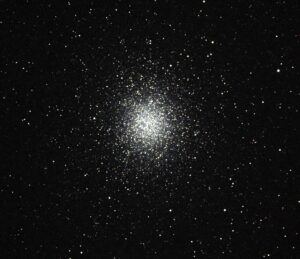
On the other side of the Cross is a bright area of the Milky Way where you will find several star clusters. You can sweep through this area looking for them. The largest and most prominent is NGC 3532 at 1,321 light years away from us. These stars have a common origin and star clusters generally dissipate after several hundred million years due to various galactic gravitational influences.
At the far side of this bright area lies the Eta Carinae nebula at 7,500 light years distant. It is a huge conglomeration of bright gas excited by the giant close double star Eta Carinae. Dark material roughly divides it into three segments. Eta Carinae itself could ‘go supernova’ at any moment. Briefly in an eruption in 1843, it became the second brightest star in the night sky. The gas and material ejected by this eruption produced the small doll shaped ‘homunculus’ nebula around it visible in telescopes.
Near the bottom of the image is the star cluster around Theta Carinae. The stars are more widely spaced and there is an interesting ‘M’ or ‘W’ alignment of a group within it that draws immediate attention.
I hope this brief introduction into some of the wonders of the night sky will encourage your further interest in astronomy.
25 April 2026
For a printable or downloadable pdf of this article, click here.