Back to Top

Category: Leisure activities

camping and caravanning; motoring; bushwalking; recreational cycling; horse riding; fishing; boating; adventure recreation; indoor recreation

Visual Astronomy from National Parks and Dark Sky sites

By Queensland-based Astronomer Peter Anderson

Whilst many of us visit nearby National Parks on day tours, we may also make trips to special National Parks a distance away requiring a traveller to spend a night nearby, or even better within the park when facilities are available. This provides a wonderful opportunity to explore the night sky.
Astronomical tourism is also encouraged in a number of country areas promoting ‘dark sky’ sites so, if you find yourself out under a dark, star-spangled, country night sky you can explore the wonders of the galaxy. How do you begin, and what do you look at? What equipment do you need?
I suggest that in advance you could download the free planetarium programme ‘Stellarium’ developed by enthusiasts and in wide use. It operates from a single screen and you are able to set up your location, date and time. It is great to explore all manner of astronomical phenomena in the past, present, and future (stellarium.org). It is easy to check out what that bright star you are seeing in the sky happens to be.
Of course I recommend a telescope, but a wonderful start is a pair of binoculars that many readers may already own. A standard pair that has magnifications between 7 and 10 will suffice nicely. The magnification is the first figure on the numbers displayed on it. For example 7X50 means 7 magnifications and 50mm diameter main lenses.
With binoculars you will readily be able to see the larger craters on the Moon, the four bright moons of Jupiter orbiting it, some of the wider double stars, many brighter star clusters and a number of glowing gaseous nebulae, especially along the Milky Way. The wider field of view of binoculars compared to telescopes, can be very beneficial in appreciating extended objects and virtually all amateur astronomers have a pair (or more) handy.
Astronomy is a fascinating subject but it does require some understanding. Nowadays one can purchase and set up ‘go to’ telescopes that will automatically find an object. One disadvantage is the extra expense, and another is that the owner will have learned very little about the night sky. I submit it is better to have learned the basics of celestial mechanics, and like riding a bicycle, the knowledge will stay with you forever. A good start would be to familiarise yourself with Stellarium and then perhaps some basic text on astronomy. The internet can also be a good source, especially ‘Wikipedia’.
But, let us assume that sometime in the next three months you find yourself outside under a dark night moonless sky in the early to mid evening and wonder what you might look at. I suggest that you face south and locate the Southern Cross. If you are not certain please refer to the photograph that will act as the guide.
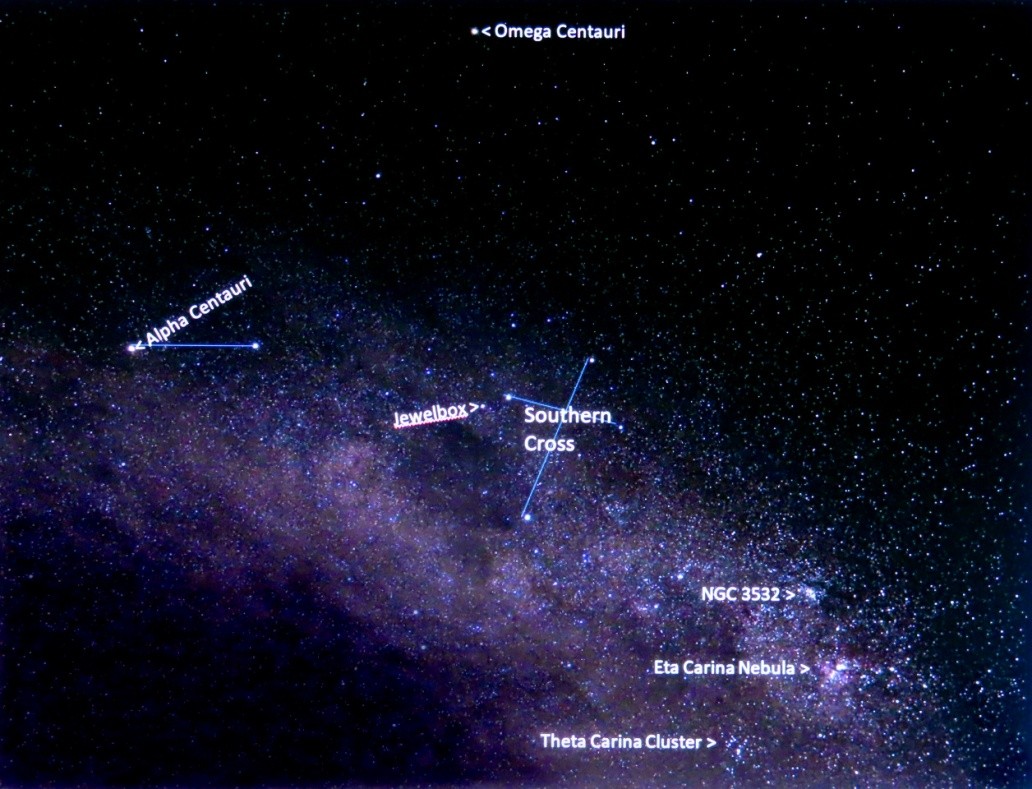
Below are images taken with a 500mm focus lens and this approximates the binocular view that I describe. All are to the same scale so are easy to relate to your view.  It is extremely disheartening to the reader if the supporting images were taken using large telescopes that have little relationship to the visual appearance in a small telescope or binoculars.


Once you have found the Southern Cross, you will see a small dark area beside it. This is a cloud of obscuring material in front of the bright Milky Way beyond and is called ‘The Coalsack’.

Stars have a huge range in intrinsic brightness as will be demonstrated by some of the statistics quoted. Our nearest star is of course the Sun and we are the third planet from it. Our distance to the Sun is eight light minutes. This contrasts sharply with the distances to stars that I express in light years, namely the distance that light travels in a year, sometimes in the hundreds and thousands. To the left or lower left of the Southern Cross there are two bright stars that point towards it, joined by a line on the image. The brighter one furthest away is Alpha Centauri, yellowish in colour and a little over four light years distant from us. The other pointer at the right is Beta Centauri 360 light years distant and hotter, being blue-white in colour. This difference in distance between 4 and 360 light years gives a good indication of their relative output of radiation since they seem fairly similar in brightness in our skies.

Alpha Centauri is a double star. Two stars are in an 80 year orbit about each other but a telescope is needed to show them. Marginally closer to us but a little over two degrees away from Alpha in the sky and gravitationally linked to it, is the red dwarf star Proxima Centauri, the closest star to our solar system. Even at such a relatively close distance it is very faint, beyond the reach of binoculars.

Next to the Cross near the Coalsack, binoculars will reveal a small triangular cluster of stars that is called the Jewelbox because in a telescope a number of its stars display different colours. The different colours of stars is caused by different surface temperatures akin to the colour and temperature of flames. Look for stars of different colours and you will certainly see the colours blue-white, white, yellow, and some orange among the brighter ones.

The bright star at the base of the Cross, Alpha Crucis (Acrux), 348 light years distant, is also a double star when seen through a telescope and these stars are blue-white. There is a nearby star (much fainter) that you will see in binoculars as being very close. It is considered to be part of the system but is more than 20 times further away than the inner pair.

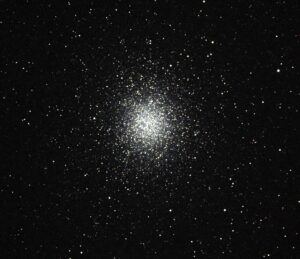
Well above the Cross in the image, you can find Omega Centauri as you sweep up your binoculars. This will appear as an unresolved blob, brighter at the centre. In a telescope this is resolved into many thousands of gravitationally bound stars. Objects of this type are called Globular Clusters, but Omega Centauri is of a huge size and may be the core of a dwarf galaxy that was captured and torn apart by the Milky Way.  It is a considerable distance away – around 17,000 light years. (The final image shows an image of Omega Centauri taken with a 15cm aperture telescope. This size of telescope is in common use by amateur astronomers and the image approximates what you might expect to see in such a telescope under dark sky conditions. Of course the larger the telescope, the more light that is gathered – as well as increased resolution for seeing finer detail.)
 

On the other side of the Cross is a bright area of the Milky Way where you will find several star clusters. You can sweep through this area looking for them. The largest and most prominent is NGC 3532 at 1,321 light years away from us. These stars have a common origin and star clusters generally dissipate after several hundred million years due to various galactic gravitational influences.

At the far side of this bright area lies the Eta Carinae nebula at 7,500 light years distant. It is a huge conglomeration of bright gas excited by the giant close double star Eta Carinae. Dark material roughly divides it into three segments. Eta Carinae itself could ‘go supernova’ at any moment. Briefly in an eruption in 1843, it became the second brightest star in the night sky. The gas and material ejected by this eruption produced the small doll shaped ‘homunculus’ nebula around it visible in telescopes.

Near the bottom of the image is the star cluster around Theta Carinae. The stars are more widely spaced and there is an interesting ‘M’ or ‘W’ alignment of a group within it that draws immediate attention.

I hope this brief introduction into some of the wonders of the night sky will encourage your further interest in astronomy.

25 April 2026
For a printable or downloadable pdf of this article, click here.

Review Status: Pending

Trails, greenways and recreational corridors

This page is a placeholder for accounts of trails and corridors and recreational use of them.


In the meantime, check the excellent websites Trail Hiking Australia and Rail Trails Australia. Rail Trails Australia lists 191 trails, such as The Red Gum Track, Hamilton to Coleraine, Victoria.

ABC Rural published an account of the Mary Valley Trail in Queensland in 2024.


Review Status: Pending

Monitoring Visitors to Natural Areas


This comprehensive guide of ~150 pages was prepared through collaboration between the authorities in Queensland and New South Wales as well as the University of Queensland. To access this authoritative material:

Open the Monitoring Visitors to Natural Areas index pdf which explains the structure of the report (and contains hotlinks to the individual subject sections, but the links have not yet been activated).

Open the Monitoring Visitors to Natural Areas assembled report, including Glossary, References and Appendices.

TABLE OF CONTENTS

List of tables iv
List of figures v
Abbreviations vi
Acknowledgements vii
Preface viii

PART 1 INTRODUCTION 1
1.1 Managing Natural Areas: Balancing Dual Responsibilities 1
1.2 Visitor Monitoring: Bridging the Gap 2
1.3 Objectives of the Manual 3
1.4 The Visitor Monitoring System 3

PART 2 GUIDELINES FOR ESTIMATING VISITOR USE 5
2.1 Introduction 5
2.2 Standardising Measurement Units 5
2.3 The Visitor Use Monitoring Process 5
2.3.1 Phase 1: Preliminary Design Considerations 5
2.3.1.1 Step 1: Clearly define the rationale for data collection 5
2.3.1.2 Step 2: Determine objectives of monitoring visitor use 7
2.3.1.3 Step 3: Familiarise yourself with the area 7
2.3.1.4 Step 4: Design a sampling plan 7
2.3.1.5 Step 5: Review alternative methods for monitoring use 10
2.3.1.6 Step 6: Select the most appropriate method(s) 15
2.3.2 Phase 2: Program Development 16
2.3.2.1 Step 7: Design a visitor use monitoring program 16
2.3.3 Phase 3: Data Analysis and Reporting 16
2.3.3.1 Step 8: Data preparation, analysis, reporting and storage 16

PART 3 GUIDELINES FOR VISITOR SURVEYS 19
3.1 Introduction 19
3.2 The Visitor Survey Process 19
3.2.1 Phase 1: Questionnaire Development 19
3.2.1.1 Step 1: Define survey objectives, resources and constraints 19
3.2.1.2 Step 2: Review methods of data collection 19
3.2.1.3 Step 3: Compare and evaluate survey modes 25
3.2.1.4 Step 4: Select the most appropriate method 29
3.2.1.5 Step 5: Determine survey questions 30
3.2.1.6 Step 6: Establish questionnaire layout and flow 39
3.2.1.7 Step 7: Evaluate the questionnaire 42
3.2.1.8 Step 8: Pre-test the questionnaire 43
3.2.2  Phase 2: Design A Sampling Strategy 44
3.2.2.1 Step 9: Determine the target population 45
3.2.2.2 Step 10: Determine the sample frame 45
3.2.2.3 Step 11: Select a sampling method 46
3.2.2.4 Step 12: Determine sample size 47
3.2.2.5 Step 13: Dealing with non-response 51
3.2.3  Phase 3: Administration of Questionnaires 53
3.2.3.1 Step 14: Scheduling the survey 53
3.2.3.2 Step 15: Select survey locations 54
3.2.3.3 Step 16: Determine staffing requirements 54
3.2.3.4 Step 17: Pre-survey preparation 56
3.2.3.5 Step 18: Distribute questionnaires 57
3.2.3.6 Step 19: Data management 59
3.2.4 Phase 4: Data Analysis and Reporting 61
3.2.4.1 Step 20: Prepare data for analysis 61
3.2.4.2 Step 21: Data entry 63
3.2.4.3 Step 22: Data analysis 64
3.2.4.4 Step 23: Report generation 67
3.2.4.5 Step 24: Data storage and retrieval 68
3.3 Survey Research: Ethical Issues 69
3.3.1 Informing Respondents 69
3.3.2 Protecting Respondents 69
3.3.3 Benefits to Respondents 70
3.3.4 Ethical Responsibilities to Interviewers 70

PART 4 CORE QUESTIONS MODULE 71

PART 5 QUESTION BANK MODULES:
STANDARD QUESTIONS 73
5.1 Visitor Characteristics Sub-module 73
5.2 Travel Characteristics Sub-module 74
5.3 Nature of the Visit Sub-module 76
5.4 Interpretation and Education Sub-module 86
5.5 Visitor Spending Sub-module 87
5.6 Visitor Satisfaction Sub-module 93
5.7 Natural Area Management Sub-module 94

PART 6 QUESTION BANK MODULES:
BEST PRACTICE QUESTIONS 95
6.1 Visitor Characteristics Sub-module 95
6.2 Travel Characteristics Sub-module 99
6.3 Nature of the Visit Sub-module 103
6.4 Interpretation and Education Sub-module 105
6.5 Visitor Spending Sub-module 106
6.6 Visitor Satisfaction Sub-module 108

REFERENCES 111

APPENDICES 115
APPENDIX I: Probability and Nonprobability Sampling Methods 116
APPENDIX II: Kondalilla National Park Visitor Survey: Format and Layout 119
APPENDIX III: Interview-administered Front End Interview Form 125
APPENDIX IV: Self-administered Front End Interview Form 127
APPENDIX V: Questionnaire Response Rate Form 129
APPENDIX VI: Reminder Letter Template for Follow-up Mailings 131

GLOSSARY 133

Review Status: Pending

“People Gardening”

Long-term recreation professional Peter Nicholls of Adelaide has generously agreed to provide the substance of materials on his website Australia’s People Gardener for re-presenting and curating on PaRC. Peter’s professional qualifications in the fields of leisure and recreation planning and development include:


  • Bachelor of Arts ANU Canberrra 1965
  • Graduate Diploma in Recreation Planning: Canberra University 1975, making him one of the pioneers of the professional recreation movement in Australia
  • Senior Recreation Planner (and various other managerial positions) with the South Australian Department of Recreation and Sport, 1976 – 1994
  • Recreation Planner City of Tea Tree Gully, Adelaide 1994 – 2002
  • Life Member and a past National and State President of his professional association, Parks and Leisure Australia.

A profile of Peter is also preserved on PaRC under the category “Inspirational People“.


NOTE: AS AT 4 SEPTEMBER 2025 THERE HAS BEEN A TEMPORARY SOFTWARE GLITCH WITH THIS PAGE. APOLOGIES TO PETER NICHOLLS AND READERS WHILE PaRC REPAIRS THE PAGE.


THE BENEFITS OF CREATIVE LEISURE INTERESTS

LIST OF LEISURE/RECREATION IDEAS. Although this document includes 2005 in its heading, that is the date it was commenced. Activities have been added continuously since then.

BEING WHO YOU REALLY ARE IS A RISK WORTH TAKING

BEWARE OF THE RETIRED HUSBAND SYNDROME

DARE TO HAVE FAITH IN YOUR DREAMS

DON’T THROW YOUR ABILITIES AWAY. RECYCLE THEM

EMPLOYERS OF CHOICE WHY THEY ATTRACT STAFF LOYALTY

FEAR AND COURAGE THE ODD COUPLE

HOW MUCH WOULD YOU TRUST YOUR TRUE SELF

I WISH I WAS THE ME I ONCE WANTED TO BE

IT’S TIME TO TEAR DOWN THE WALL THAT SEPARATES WORK AND LEISURE

LIFE AFTER WORK WILL BE LIKE NOTHING YOU HAVE EVER KNOWN BEFORE

MY APPROACH TO EXPONENTIAL PERSONAL GROWTH AND DEVELOPMENT

MY DREAM FOR THE WORLD

MY LEFT FIELD PERSPECTIVE

SETTING THE STAGE

SPACE THE SEPARATION THAT KEEPS US TOGETHER

THE CHANGING ROLE OF BUSINESS IN MAKING SENSE OF WHY WE ARE HERE

THE ENQUENCHABLE YEARNING TO FOLLOW YOUR HEART

THE GLORIOUS ENIGMA OF UNCERTAINTY

WE NO LONGER ACCEPT LIFE IS OVER WHEN IT

WHY I WANT TO BE A KID AGAIN

WHY IT’S TIME FOR A PARADIGM SHIFT TO CONTINUOUS DEVELOPMENT


The above 23 files AGGREGATED

To be continued.

Review Status: Pending

Queensland Government Statewide Outdoor Recreation Framework

In 2014 the Queensland Government issued a policy statement endorsed by 17 public authorities, the Local Government Association  and the peak body for outdoor recreation, the Queensland Outdoor Recreation Federation. Titled the Queensland Government Statewide Outdoor Recreation Framework: A Collaborative and Coordinated Approach to Outdoor Recreation in Queensland, to achieve endorsement from such a large number of authorities was no mean feat. The statement was intended to replace an earlier one Queensland Outdoor Recreation Strategic Framework 2009—2014 which had run its course.

The Framework was designed to protect and improve access to outdoor recreation places and spaces; promote outdoor recreation opportunities and participation; and enhance the sustainability and capacity of the outdoor recreation sector.

Yet despite the fact that there is nothing political in the statement, after the government was replaced by one of the opposite partisan denomination the following year, the Framework disappeared from the Department’s public website and public servants were instructed by the incoming government to work on something different.

It is not difficult to be quite angry at the waste of human capital when the work of representatives of 19 different entities is discarded in this manner. Anyone who has worked in an interdepartmental role will understand how time-consuming it is to gain endorsement of their agency to a multilateral policy position.

It gets worse. By law, all Queensland publishers, including government departments, commercial organisations, clubs, churches, societies and private individuals, are required by law to deposit one copy of their publications with State Library of Queensland (SLQ). The document appears in the SLQ catalogue, but clicking on the hotlink within the catalogue record yields the following message:

Oops, page does not exist!

Fortunately, the Queensland Outdoor Recreation Federation (now Outdoors Queensland) salvaged a copy and PaRC is pleased to re-present it here.

Researchers in this field should also search the PaRC Document Library which includes a number of reports on the subject, including the Outdoor Recreation Demand Studies of 1998 and 2007.

Review Status: Pending

Tread Lightly!

Tread Lightly! (Australia) was a community organisation established to promote responsible use of outdoor recreation sites by users. Queensland public servant Neil Ames has assembled this narrative, based upon recollections of the late John Wood, who was president for 10 years.

The model came from the United States where Tread Lightly (US) is still very alive and functional: see https://www.treadlightly.org/. Its mission has been “Promoting responsible recreation through stewardship, education and communication. Plus, we get out there and live it.” Tread Lightly (US) originated from the US Forest Service which wanted to partner with recreational users of forests to minimise recreation-related impacts resulting from all types of outdoor activities including off-road vehicles (mountain biking, bushwalking, camping, fishing, hunting etc).

Jan and Ivan Scudamore introduced the program into Australia in the early 1990s. Jan was Executive Officer of Tread Lightly (Australia) from its inception and the driving force. Tread Lightly (Australia) had a board and three chairmen over the ~10 years of operation, namely Brian Woodward, Rob Seymore and John Wood. Jan was also a board member of Tread Lightly (USA) and acquired a quantity of educational, training, promotional, research, management and operational material from the US Forest Service and the Off Highway Vehicle Association of USA.

Eventually it was decided to close Tread Lightly (Australia) down due to lack of financial support.

After an interregnum in the offices of Sport and Recreation Queensland based in Toowoomba, the collection of physical resources was secured by PaRC and many items scanned. The materials are not saved in a single digital location in the library, as the library is based on a keyword search engine, but the items that are not copyright are now accessible to all.


The Tread Lightly Education Kit (67 MB) that came into PaRC’s possession consists of a folder containing a copy of the leaflet, the Teachers Guide and Data Sheets.


A leaflet sponsored by the Victorian Department of Conservation and Natural Resources and dated 1993.


John Grieg authored a 17-page paper to the 10th Annual Conference entitled Appropriate Use of the National Parks System – An Off-Road Vehicle Users Perspective, dated 1987.


Review Status: Pending

Mountain Biking Impacts and Rider Preferences

This paper is an extract from the Proceedings of the New Zealand Recreation Association Conference, Mt Cook, New Zealand 1995, pp 61-71. Mountain Biking Impacts and Rider Preferences” by Gordon Cessford, Science and Research Division, Department of Conservation, Wellington, New Zealand.

A review of impacts from mountain biking concludes: that the physical impacts of mountain biking are not a good basis for decisions about allowing access, that the actual environmental impact and safety hazards associated with mountain biking may be less than perceived by other track users, and that the focus needs to be on recreation conflict issues. A survey of riders found that they displayed a diversity of setting and experience preferences, and many of these changed in importance with riding experience. Natural settings, challenging riding, variety, and
opportunities for excitement and speed were important components for most riders. From these results, recommendations for management of mountain biking and associated research are made.

Review Status: Pending

SportsFun – A Queensland program

People may ask why PaRC publishes documents written a couple of decades ago dredged up from various private and public collections. Partly this is because some of these old reports and old programs will be useful source material for historians and researchers; partly because they can be cut and pasted into modern documents.

We believe that many modern practitioners are let loose in their local government or departmental office without sufficient mentoring, given the turmoil and turnover in the state and national public services. But we ask PaRC readers to send us modern editions where old documents have been superseded.

SportsFun is a guide to making sports activities appealing.

The rear cover includes credits and copyright statement.


Review Status: Pending

MidCoast Public Toilets in Parks Strategy 2025 – 2035

MidCoast Public Toilets in Parks Strategy


Land managers, primarily councils, put a lot of assets into parks and reserves. Sports infrastucture, amenity buildings, playspaces. One of the most significant assets that we provide in our parks are public toilets. Public toilets are built in our parks because it is the only land that councils own, but more importantly, parks are major attractors for visitors, and it is people that are away from their homes, spending long periods of time, that are the main users of public toilets.


MidCoast Council has just adopted its new MidCoast Public Toilets in Parks Strategy. We have 108 public toilets in total, and 106 of them are in our parks and reserves. This represents a major investiment, with a single public toilet costing a minimum of $250,000, but often are closer to a million dollars. When you have a hundred of them that is a massive CAPEX investment. But public toilets are also our most expensive OPEX asset as well. They have to be cleaned once or twice a day. And they are also the target of vandalism, with cisterns being broken on a regular basis.


A public toilet strategy is a critical planning mechanism, as part of a larger parks planning portfolio.

Review Status:

Recreation Management Workshop – Brisbane Forest Park, October 1985

This compilation (29 MB) has far more useful information about the resources of the Brisbane Forest Park region than the title suggests. There are valuable accounts of the region’s natural resources, for just one example.

Management Perpectives
Regional and Community Perspectives – Dr. David Pitts 1.
Management of Brisbane Forest Park – Mr. Bill Carter 5
Management of National Parks – Mr. Mark Gough 11
Water Catchment Management – Mr. Bill Huxley 17
Mt. Coot-tha Management – Mr. Ross McKinnon 45
Forestry Management – Mr. Geoff Swartz 51

Park Resources
Research and Management of Geo-resources – Mr. Errol Stock 61
Soils – Mr. David Aust 73
Vegetation – Mr. Peter Young 83
Aquatic Resources – Mr. Hamar Midgley 99
Animal Resources – Dr. Kristene Plowman 105
Archaeological Record & Implication Introduction – Mr. Bob McQueen 109
Historical Record – Mr. Peter Marquis-Kyle 115
Counting the Users – Dr. Lex Brown and Ms. Leanne Wilks 121
Educational Uses by Brisbane C.A.E. – Mr. B. Cooke & Mr. I. Marsh 129

The Data Base
Rainforests – Mr. Bill McDonald 1.53
Open Forests and Woodlands – Professor Trevor Clifford 165
Climbing Plants – Ms. Elwyn Hegarty 169
Lichens – Dr. Rob Roberts 181
Themeda/Imperata Grass under story of Open Eucalypt Forest – Mr. Hendrik Dierich 187
Ecology of. Ferns and Fern Allies – Mr. Peter Bostok 189
Life Expectancy of Leaves of Wilkea macrophylla at Mt. Glorious – Dr. Rob Rogers 195
Vertebrate Fauna – Dr. Kristine Plowman 199
Management Studies – Mr. Peter Ogilvie 223
Utilisation of Lantana camara by Birds and Small Mammals – Dr. Peter Driscoll and Mr. Greg Quinlan 239
Habitat Utilisation by Rattus fuscipes and R. tunneyi – Mr. Neil White 247
A Suggested Timing for Controlled Forest Burning Based on Observations of Fledgling Vulnerability in Moggill State Forest – Mr. Peter’ Slater

Management Influences
Community Influences – Mr. Ken Stevenson 263
User Impacts in Rose Gum Flats. Picnic Ground – Mr. David Bluhdorn 269

Futures for and around Brisbane Forest Park
Recreation Planning For The Future – Ms. Dale Anderson 279
A possible future for Brisbane Forest Park – Mr. Bill Carter 285
A Viewpoint from the Department of Forestry – Mr. Peter Cranny 289
National Parks – Mr. Noel Dawson 295

Workshop Reports
Floristic Data Base Implications, Deficiencies and Recommendations – Dr. Bob Johnson.. ………….. 303
The Animal Data Base Dr. Greg Gordon & Dr. K. Plowman 307
Notes on Seminar-Management Influences – Dr. John Waite. …… 315
Notes on Seminar-Management Influences – Dr. David Lamb…… 319

Review Status: Pending

Freshwater Fish of the Yarra River

This mimeographed description of the native and introduced Freshwater Fish of the Yarra River has a pencil mark August 1984 on the front cover and is presumably the date it was compiled by the Department of Conservation Forests and Lands on Behalf of the MMBW.

PaRC is not a conservation archive, but this report qualifies for inclusion as fishing is a major recreational activity in greater Melbourne.


Review Status: Pending

Toowoomba Cycle and Pedestrian Strategy 2002

This ~68-page strategy, (55 MB) published in March 2002 and prepared inhouse by officers of Toowoomba City Council, aims to improve “the equity, accessibility, convenience and safety of cycling and pedestrian travel” for residents and visitors.

Principles articulated in the report:

  1. Consultation should be an open and accountable process and participation and input should be encouraged from all of the community, throughout the development and implementation of the strategy.
  2. Cycling and walking* need to be recognised as integral parts of the transport system and be considered in all landuse planning and transport designs.
  3. Cyclists can ride on the road or use paths (unless signed otherwise) and this choice should be supported with the appropriate combination of on-road and off-road facilities and integration into the planning and design of road networks.
  4. Facilities should be designed to encourage safe and responsible sharing of pathways and roadways by accommodating the different travel speeds of users.
  5. Education should form part of the provision of infrastructure to encourage people to use it appropriately and safely.
  6. Partnerships with other agencies, private enterprise and community groups are required for successful implementation of this strategy.
Review Status: Pending

Charter for Leisure

The World Leisure Organization passed the updated Charter for Leisure in 2020. Its text reads:

Articles
1. Everyone, whether adult or child, has the right to adequate time for rest and for the pursuit of leisure activity.

2. For those engaged in remunerated work, Article 1 requires recognition of the right to reasonable limitation of working hours and periodic holidays with pay, as well as remuneration for public holidays. Securing these rights generally requires national/ provincial legislation.

3. Article 1 also applies to those engaged in unpaid labour, for example domestic care-givers.

4. Everyone has the right to freely participate in the cultural life of the community.

  • Culture is viewed by the UN Committee on Economic, Social and Cultural Rights as including:
    ‘music and song, ceremonies, sport and games, natural and man-made environments’ and ‘the arts, customs and traditions through which individuals, groups of individuals and communities express their humanity and the meaning they give to their existence’. These activities depend on the provision of: ‘libraries, museums, theatres, cinemas and sports stadiums; literature, including folklore, and the arts in all forms; the shared open spaces essential to cultural interaction, such as parks, squares, avenues and streets; nature’s gifts, such as seas, lakes, rivers, mountains, forests and nature reserves, including the flora and fauna found there’.[i]
  • Participation in social and cultural activities includes engagement as: an active participant, a learner, a spectator or audience member or an unpaid volunteer.

5. Leisure is also a medium through which other rights and related benefits set out in the Universal Declaration of Human Rights and associated covenants can be exercised, including: the physical, mental, emotional and social development of the child through play; support for family life; personal expression and development; sustaining of cultural life of the community; and promotion of physical and mental health and well-being through sport, physical activity and cultural engagement. Conversely, denial of time for beneficial leisure activity can have serious consequences for the well-being of individuals and societies.
6. These rights should therefore be observed and supported by all of society’s institutions, including commercial organisations, education institutions, professional bodies and non-government organisations. Governments at national, regional/provincial and local levels have particular responsibilities reflecting commitments under United Nations treaties and, in some cases, provisions in national constitutions and legislation.
7. Recognising that governments at all levels are not the only providers of facilities and services for leisure and that they face many challenges and competing demands for resources, they nevertheless have particular responsibilities to:

  • ensure availability and protection of land for open space for recreation in residential areas;
  • ensure preservation of, and public access to, natural and culture heritage;
  • ensure the provision of suitable space and facilities for children’s play;
  • support provision of health-enhancing amenities, such as facilities for sport and exercise;
  • support cultural institutions and activities;
  • ensure that all members of the community, regardless of age, gender, sexual orientation, ethnicity, religion, ability or income, have access to beneficial leisure facilities and services;
  • support suitable training of a technical and professional work force for the leisure/ sport/cultural service industries;
  • support research on the benefits and costs of leisure activity and on the provision of leisure facilities and services;
  • include recognition of leisure-related rights in relevant national/provincial legislation and regulations, including those concerned with regulation of mass communications and digital media;
  • recognise, in national, regional and urban policies and plans, the contribution which leisure-related provisions can make to personal, social, cultural and economic development;
  • support other human rights which facilitate the participation in the cultural life of the community, including the right to food, clothing, housing and medical care and necessary social services and security, as set out in Article 25 of the Universal Declaration of Human Rights.

[i] UN Committee on Economic, Social and Cultural Rights (2009). Guidelines on Treaty-specific Documents to be Submitted by States Parties Under Articles 16 and 17 of the ICESCR. Document E/C.12/2008/2. New York: UN, pp. 4-5.

Review Status: Pending

Parks and Recreation Portfolio Planning Presentation

Parks and Recreation Portfolio Planning


This is a presentation that I gave at the Parks and Leisure Australia (PLA) 2024 National Conference in Brisbane.

The presentation outlines the portfolio approach to planning for parks and recreation.

Review Status:

Port Moresby and Beyond

This rather charming memoir of a personal journey along the Kokoda Track is by Ron Turner, former Ranger in Charge and District Ranger in Victoria’s and Queensland’s national parks systems.


Ron is an accomplished writer: see his First Ranger: A Memoir and Cooloola and its Hinterland in our Document Library as well as his lighthouse series (also relevant to PaRC) indexed on the website of the Queensland Science Network.

Review Status: Pending